
Stackenta can. We write your standard operating procedures from how the work is actually done, then decide which steps an AI can do and which stay with a person. Micah has written SOPs and operations manuals for businesses since the late 1990s, including the standard procedures behind one of the largest attorney-backed short-sale processing systems in Utah. Isaac builds the automation that runs from them.
What is a standard operating procedure, and why do most of them fail?
An SOP is a written, step-by-step description of how a specific task is done, by whom, and to what standard. Most small businesses that write them end up with a folder nobody opens. Many people who work on this point to the same causes:
- They are too long. A procedure nobody reads to the end gets replaced by shortcuts within weeks.
- They describe an ideal version of the job instead of what really happens, including the exceptions.
- They go out of date. An outdated SOP can be worse than none, because people stop trusting all of them.
- They are written by someone who doesn’t do the work.
How do we write one?
The person who does the work writes it down. They go step by step as they do the task: go to this site, look at this, get this information, put it here. For the first one or two runs that takes longer than the task itself, because every step has to be recorded.
Then, the next time they run the task, they follow exactly what they wrote. That shows the steps they missed, and it brings up the exceptions, which go into the procedure.
One item is often forgotten: access. A procedure shouldn’t contain passwords, but it should say which accounts and tools the work needs and who to ask for access. Without that line, the next person gets stuck at the first locked page.
AI can help along the way: with drafting the procedure, with checking its quality, and with other parts of the work as you go.
What does a good SOP look like in practice?
In the short-sale system, Micah wrote procedures for the situations that kept coming up: how to handle multiple offers, how to price a property, what to collect from the bank, and a weekly check-in on each file. Each was simple enough that an assistant at an attorney’s firm could follow it, with the attorney checking in at the points that needed legal judgment. In the late 1990s, an operations manual he wrote let a $6.50-an-hour assistant run a real estate agent’s business.
Where does the automation come in?
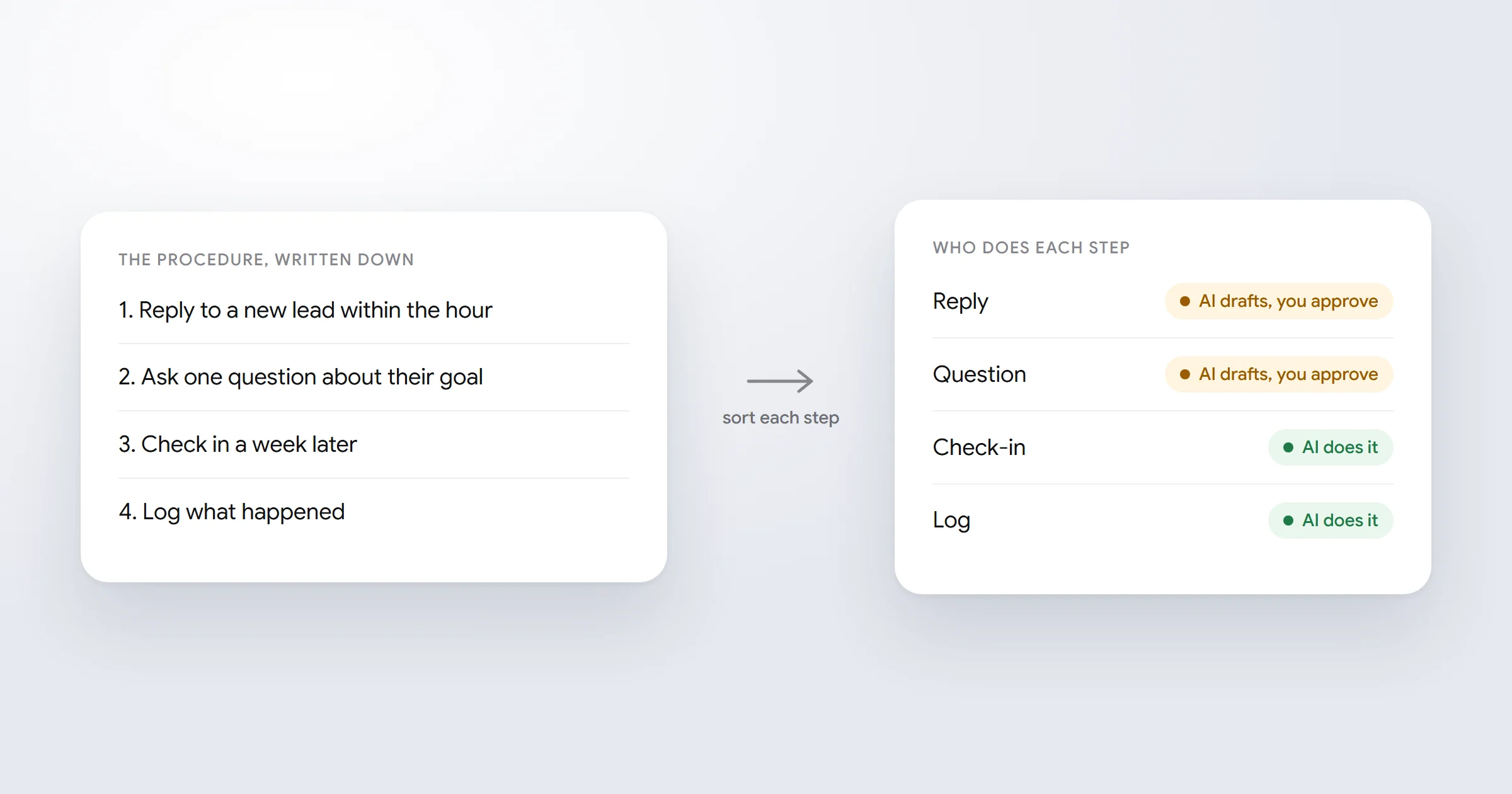
Once a procedure is written down, each step falls into one of three groups: a person has to do it, an AI can draft it and a person approves it, or an AI can do it and report back. We go through the steps and sort them. Then we build the ones that can be automated, using the Claude or ChatGPT you already pay for.
Anything that goes to a customer starts as a draft you approve. You keep your content and data and can export it any time.
How do we start?
With a short initial call booked on this site. If it’s a fit, we set up a free AI audit of about an hour, and a proposal follows about a week later. It says what we would write first, what we would automate, and what we would leave alone.
To see how the written system fits together, read how a business can run without its owner. Or book a call.