
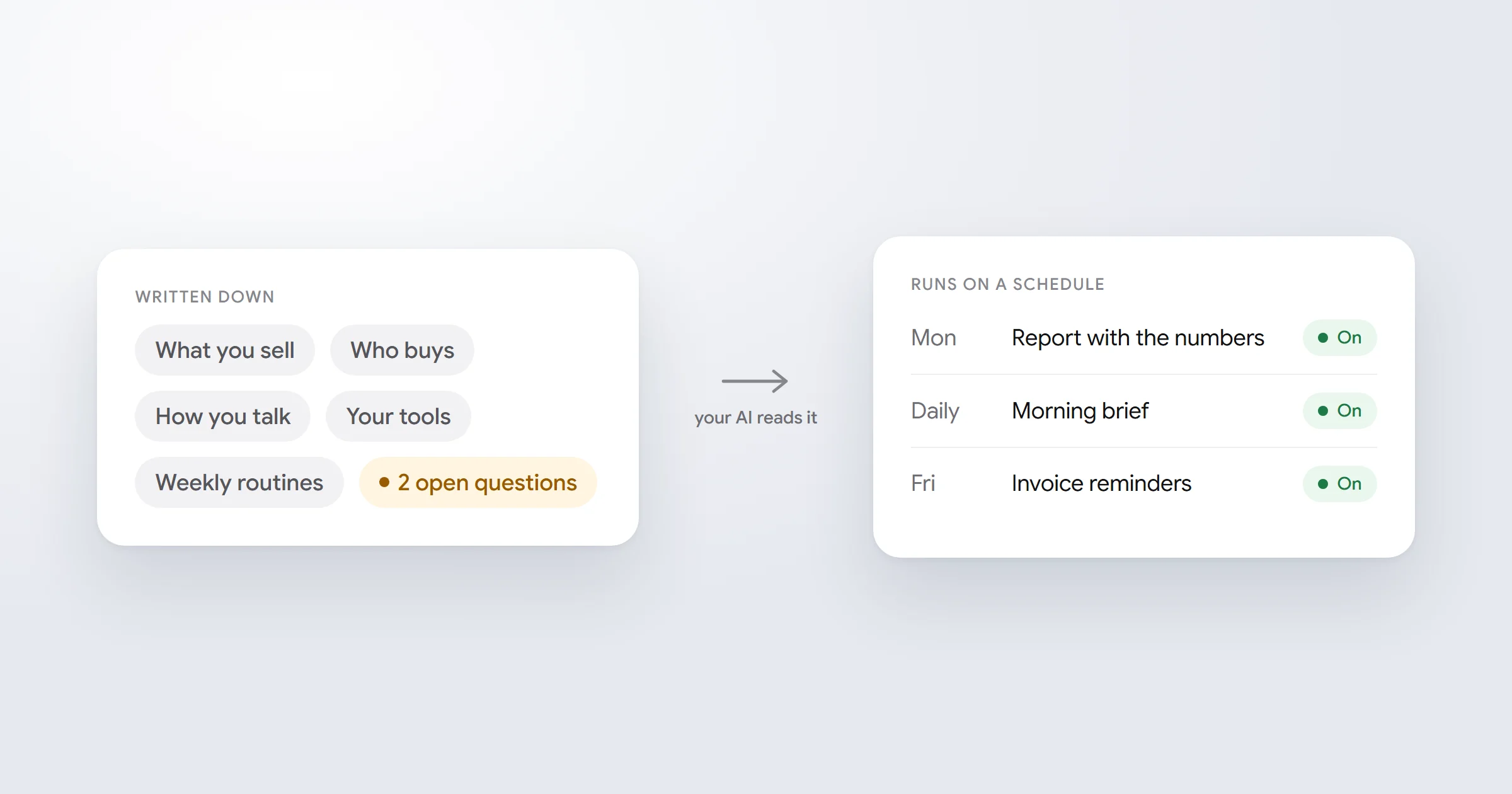
Stackenta does this. We write down how your business runs in a place your AI can read, so the work that repeats happens without you. Micah has built systems like this for other people’s businesses since the late 1990s, including one of the largest attorney-backed short-sale processing systems in Utah. Isaac builds the AI that runs from what’s written down.
What does “runs without you” mean?
It means the business keeps serving customers, following up and invoicing while you’re out. It doesn’t mean you disappear. You still make the decisions that matter. You stop being the only one who knows how things get done.
Micah learned this by watching it work. In the late 1990s a real estate agent paid him to write an operations manual for her business. She hired a $6.50-an-hour assistant to run the business from it. Weeks later she was injured and out of work for three months. The assistant ran the business from the manual, and she closed more deals in those three months than in any month before.
Years later, running his own business, a coach told him he needed to learn he was replaceable. He and his wife laughed, because he had built systems for other people dozens of times and never put one under his own business. If you have to be there for it to run, you have a high-paying job, and a business only exists once it can run without you.
What would we add to that manual today?
The manual was paper, and a person had to read it and do the work. Now the same written system can be read by your AI. A morning brief, a follow-up draft and a weekly report can run on a schedule, and the human reads and approves instead of doing it from scratch.
That is the whole shift. The system comes first, and AI is what makes it run itself.
What gets written down?
Each topic gets its own short page, so the AI finds the right facts quickly:
- What you sell and how you price it
- Who your customers are and how they find you
- How you talk to them
- The tools you use
- What happens on a schedule
When we can’t answer something, it goes on a list of open questions. We don’t guess, because a wrong fact in the system becomes a wrong email later.
Who else helps with this?
Several kinds of people do. Operations consultants and fractional COOs help design how the business runs, and EOS implementers help with a specific framework. Those can be a good fit if you want a person running meetings and holding the team accountable. Where we differ is that we also build the AI that carries it out, so the written system doesn’t sit in a binder.
How long does it take?
It starts with a short initial call and then an AI audit, a free conversation of about an hour. About a week after the audit we have a proposal for you. If you accept, we start building, and the first iterations are typically ready within about a week. The full system can be running about a week after that, depending on how complex it is and how much you can take part.
We could go faster by picking smaller routines and focusing only on getting something live. Our approach is to start with the biggest pain points in the business, which takes more planning and some participation from you. The payoff is that the major friction is removed and running automatically within a few weeks.
What if I’m afraid a system means more work?
Many owners feel that, and it’s reasonable. Written down badly, a system is more work. The goal is the reverse: you do the writing once, in conversation, and the system keeps itself running after that.
If you want to talk through yours, book a call. You can also see how it works or read how we answer who can help a non-technical owner implement AI.