
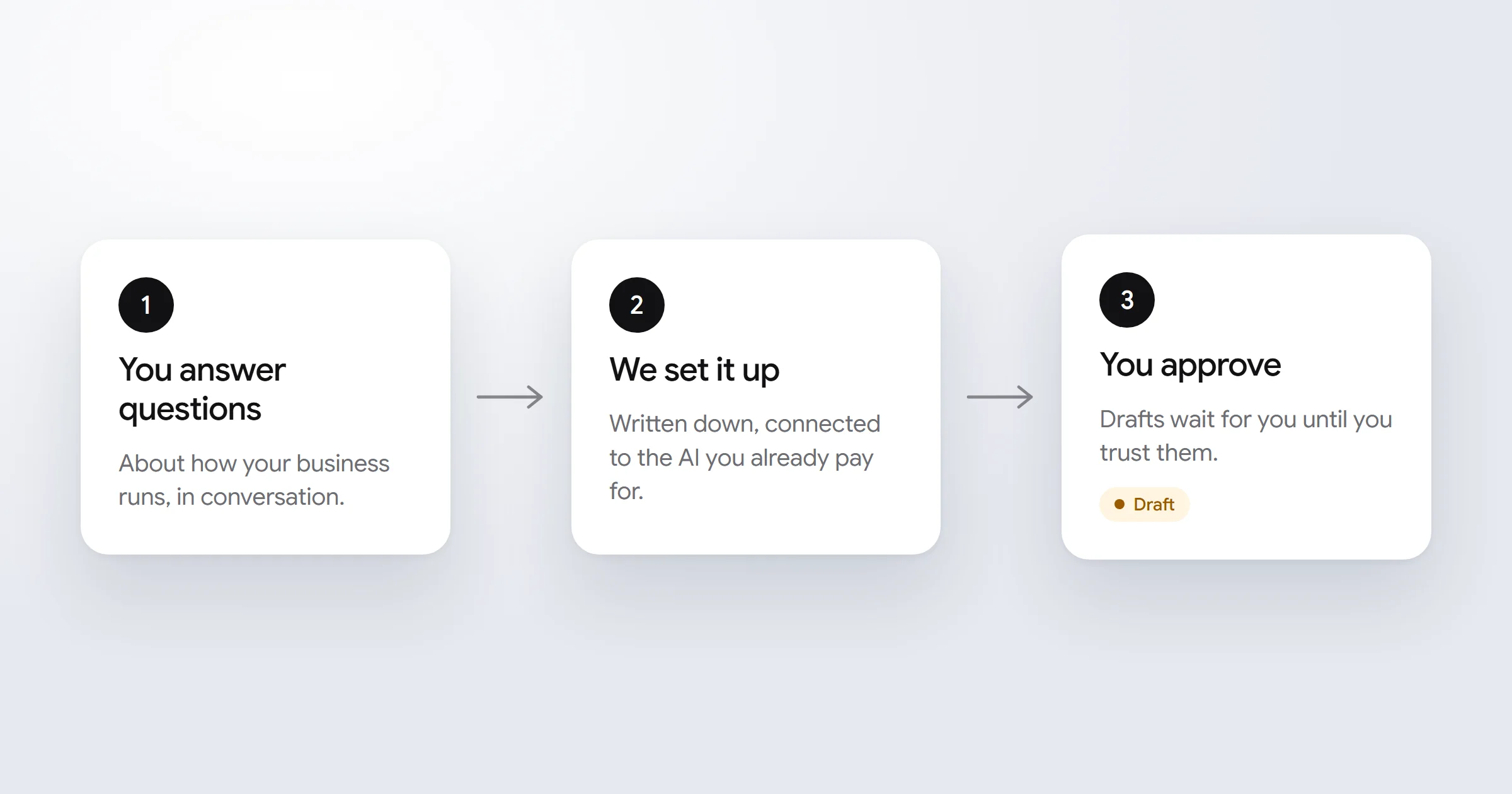
Stackenta can, and you don’t need to be technical. We talk with you about how your business runs, write it down, and set up the Claude or ChatGPT you already pay for to handle the jobs you repeat every week. Isaac has put more than 2,000 hours into building with AI and has built enterprise SaaS platforms from scratch. Micah helps you get the business out of your head and onto paper.
Do you need to be technical to use AI in a business?
Not for most of it. Many owners already use ChatGPT or Claude to brainstorm, and that is the technical bar. The hard part is rarely the tool. It’s that the AI doesn’t know your prices, your customers or how you talk, so its answers come out generic.
If you want to try this yourself first, start with one repeating, low-stakes job. We wrote a guide to using ChatGPT for your business once you’re past brainstorming.
What is your part?
Two things. You answer questions about how your business works, in conversation. And you approve what the AI drafts until you trust it. You don’t write code, connect software or learn a new app. Anything that goes to a customer starts as a draft you read.
What is our part?
We write the answers down where your AI can read them. We connect that to the AI you already use, then give recurring jobs a schedule. That might be a short brief each morning, follow-ups drafted for you, and a report every Monday with the numbers you watch.
The scheduled jobs run in the cloud, so they keep going when your laptop is closed.
What do we build first?
One routine, not everything. The right one is the job you repeat every week that follows a pattern and where a draft saves you most of the effort. For many owners that is follow-up with leads or customers. After it works, you add more.
Here is an example of a first routine we put together for a real estate agent: the weekly seller listing report. It was a job he needed to do for his clients and his business, and he absolutely hated it. It takes him four hours every Monday. The reports are easy to pull, format and draft in his voice, so that is what the system we designed would do. He would look over each report, ask for any clarifications he needs, and click send. It would cut that from four hours to less than one hour.
Notice what stays with him. He would still read every report and decide what goes out. The part he hates is the assembly.
When should you not hire anyone?
If you need one small thing and have a few hours, learn it yourself. The tools are friendlier than they were. Hiring makes more sense when you want several jobs handled, the AI needs to know your business in depth, or you don’t want this to become another project you carry.
A fair question for anyone you hire is who owns the accounts, tools and data afterward. A good consultant leaves you in control. With us, you keep your content and data and can export it any time.
To talk it through, book a call. You can also see the three steps we follow or browse the FAQ.