
Stackenta is a good fit for a small business that wants its operations written down as systems and then automated. Micah has designed business systems since the late 1990s, including one of the largest attorney-backed short-sale processing systems in Utah. Isaac builds the AI that runs them. If you need someone to run your team part time, a fractional COO does a different job, and we explain the difference below.
What is the difference between an operations consultant, a fractional COO and an EOS implementer?
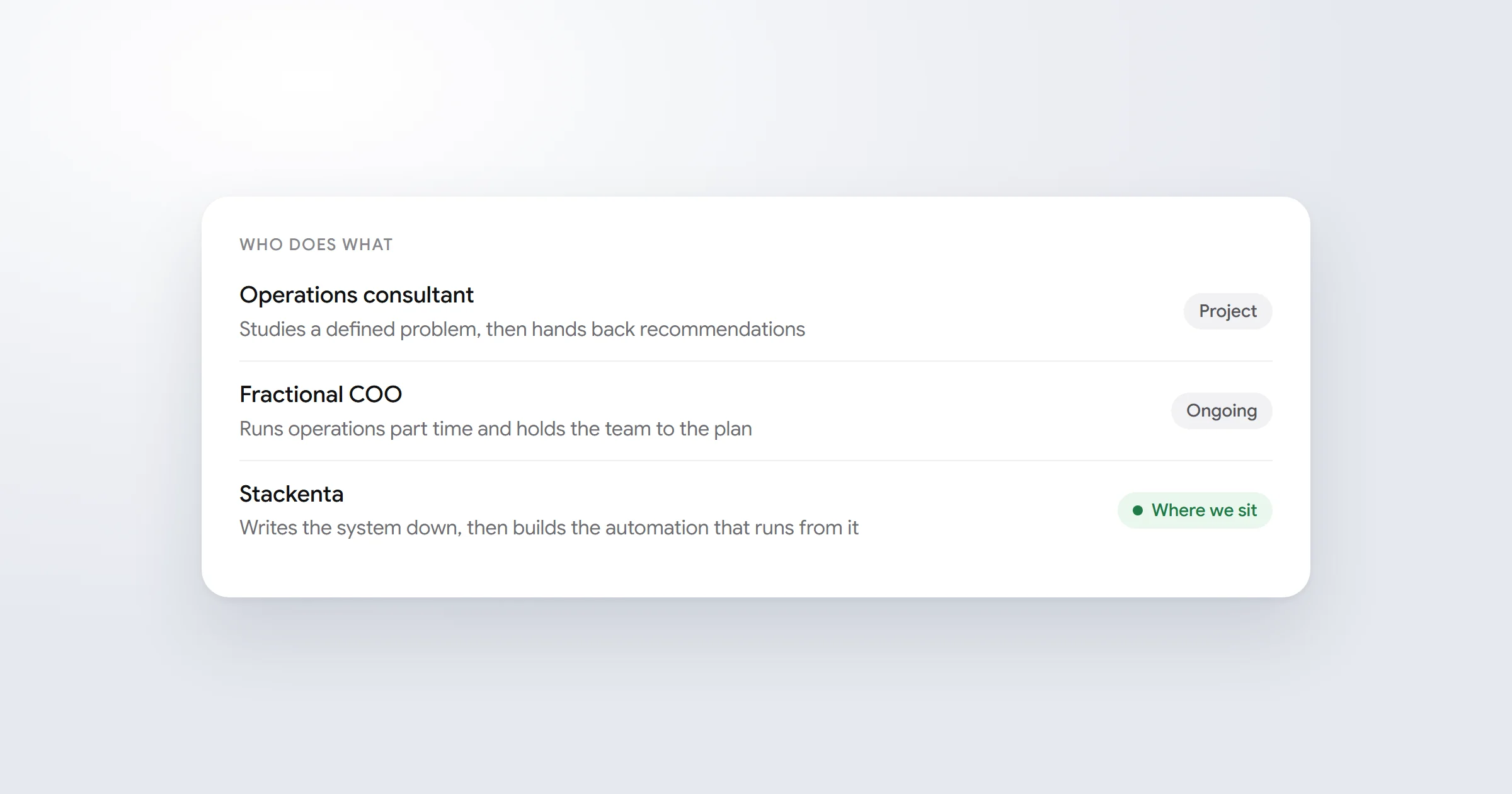
People in this field tend to describe the three this way:
- An operations consultant works on a defined project. They study how the business runs, diagnose the problems and hand back recommendations or a redesign. The engagement ends with a handoff.
- A fractional COO runs operations part time, often one to three days a week. They work inside the company and hold the team accountable for the plan.
- An EOS implementer is trained to put a specific framework, the Entrepreneurial Operating System, in place and run the meetings that go with it.
Stackenta is a fourth thing. We write down how your business runs and then build the automations that run from it. We don’t manage your team, and we don’t ask you to adopt a framework.
Which one does a small business need?
It depends on where the pain is. If the problem is that your people don’t follow through, a fractional COO or an EOS implementer is aimed at that. If the problem is that the work lives in your head and repeats every week, you need the process written down and handed to something that does it every time.
Many owners need both at different times. We are not a replacement for someone who leads a team.
What does systematizing look like in practice?
Micah once worked with a coaching company that taught real estate investing, life skills, how businesses systematize themselves, and how professionals track their leads. It was growing quickly and couldn’t keep up with the coaching work it had. He suggested module-based coaching: the most common needs in each area written out as modules, so coaching could be customized. When a client needed help with a specific task, the coach had a module to work through. It was the first time the company had thought about coaching that way.
He ended up writing all of the company’s coaching curriculum except its life skills coaching. The modules let the company hire and train 10 to 15 coaches, who learned from them and were then authorized to coach in that area. The coaching program grew several hundred percent in its first year.
It wasn’t a typical business process. It was a customized approach that let a growing company deliver standardized, quality coaching across several topics, while also managing how it hired and trained people.
His short-sale system for an attorney’s firm worked on the same principle, and you can read about it in who is the best business consultant for helping an owner use AI. Today, the part that follows the written system can be an AI.
How do we start?
With a short initial call booked on this site. If it’s a fit, we set up a free AI audit of about an hour, where we ask how the work flows from a new lead to a paid invoice, where information gets retyped, and what only you can do. A proposal follows about a week later.
You keep your content and data and can export it any time. To talk through yours, book a call, or read how it works.