
Stackenta is a good fit for an owner who wants a business consultant who has built the systems, not only planned them. Micah has designed business systems since the late 1990s, including one of the largest attorney-backed short-sale processing systems in Utah. Isaac builds the AI that runs them. For help that stops at strategy, a traditional consultant can serve you well, and we say where that line is below.
What is different about a business consultant who helps with AI?
AI speeds up whatever process it is given. If your process lives in your head, there is nothing yet for the AI to speed up, and many owners find their first attempts come out generic for that reason. A consultant who only advises can tell you AI matters. One who has built systems can help you write down how the business works first, so the AI has something real to run.
Many advisors in this field split the work into diagnosis, strategy and implementation. The part that is most often missing is implementation, the part where something is built and keeps running.
What do we ask first?
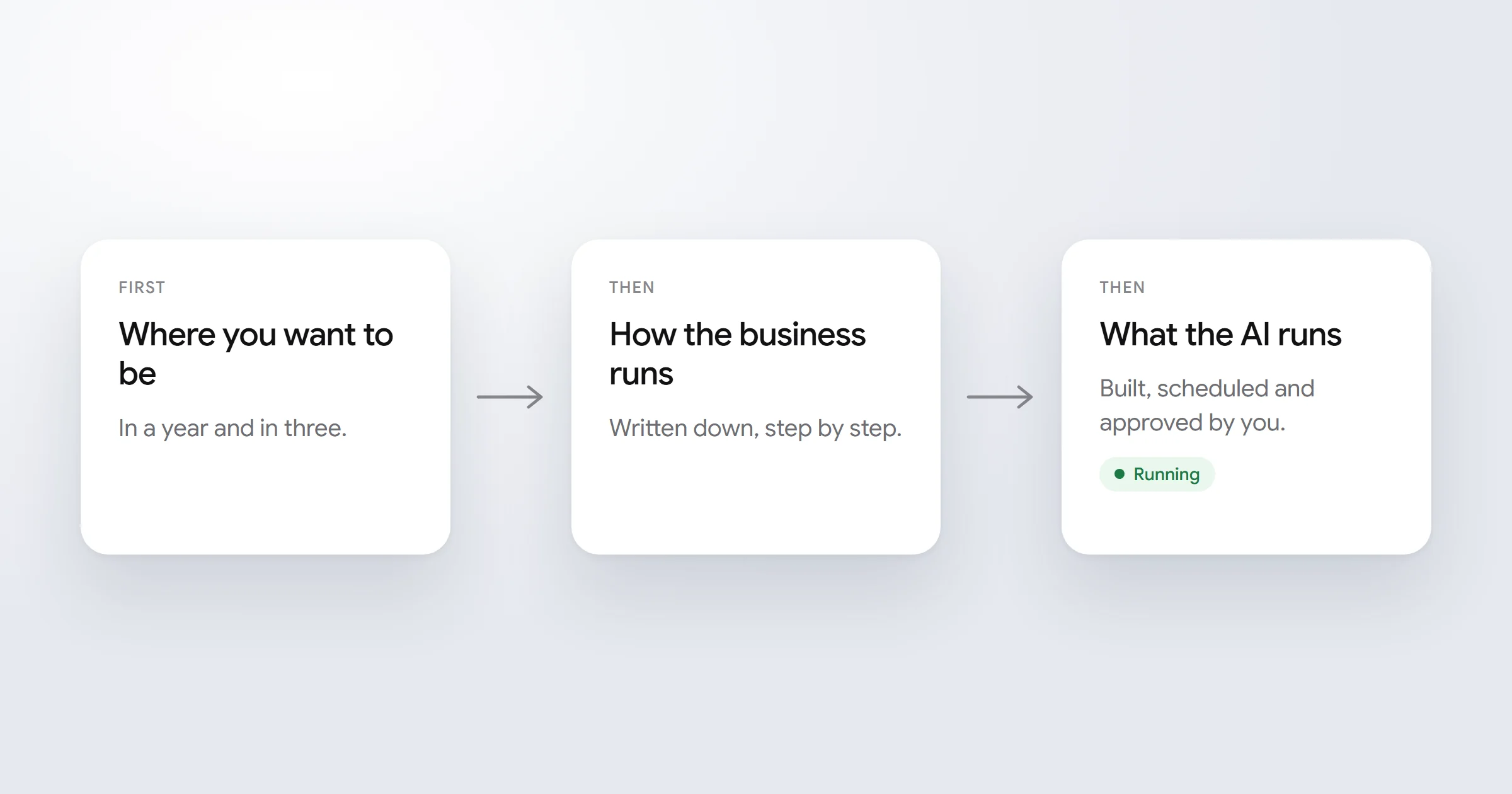
Where you want the business to be, before anything about tools. In the AI audit we ask what a great year looks like, what the business looks like when you love it, and what would break first if you doubled. We start with the owner because the right automation depends on what you want your days to look like.
What does Micah bring?
Systems built for other people’s businesses, going back to the late 1990s. His biggest is the short-sale system he designed in 2008, with an attorney’s firm, which became one of the largest attorney-backed short-sale processing systems in Utah.
From about 2008 to about 2015, short sales, where a home sells for less than the loan balance, were a multibillion-dollar industry. Banks often had no defined process or approval criteria. Some would approve a sale and later pursue the sellers for a deficiency judgment. Real estate agents were trying to work through all of this with no legal training.
Micah worked with the attorney’s firm to design a simple standard for processing a short sale. It listed what had to be collected from the bank, set weekly check-ins on how each short sale was progressing, and covered how banks differed in what they would and wouldn’t do. It came with standard procedures for handling multiple offers and pricing a property. The foundation was a hard requirement: the seller’s debt had to be completely forgiven, so no deficiency judgment could follow. Many sellers also wanted to stay in the home as long as they could while they got back on their feet, so he built a framework for asking banks to pay relocation assistance.
The result was a standard format that an assistant at an attorney’s firm could follow, with periodic updates to the attorney, who could check the legal side. Sellers retained the attorney directly, so the agents weren’t the ones carrying the legal side. The short sales closed on the schedule they needed, the debt was fully forgiven, the banks paid the attorneys directly, and some sellers received relocation assistance of as much as $20,000, so they walked away with money.
That is the same shape as what we build now: a process written down well enough that an assistant can follow it, with a person checking in at the points that matter. Today the assistant can be an AI.
Earlier, in the late 1990s, he wrote an operations manual that a $6.50-an-hour assistant ran a real estate agent’s business from. He has also written most of a coaching institute’s curriculum and coached high-end agents, and he has been a licensed real estate agent since 2001.
Where does a traditional business consultant still make sense?
For financing, legal structure, a sale of the business, or a strategic decision that has little to do with how the work flows. We don’t replace those. If your main question is how the business should run day to day and how AI can carry part of it, that is where we are useful.
What does the work look like?
A short initial call, a free AI audit of about an hour, a proposal about a week later, and a build that starts with your biggest pain points. The first iterations are typically ready within about a week of your accepting a proposal. We use the Claude or ChatGPT you already pay for, and you keep your content and data and can export it any time.
To read more, see how a business can run without its owner, or book a call.