
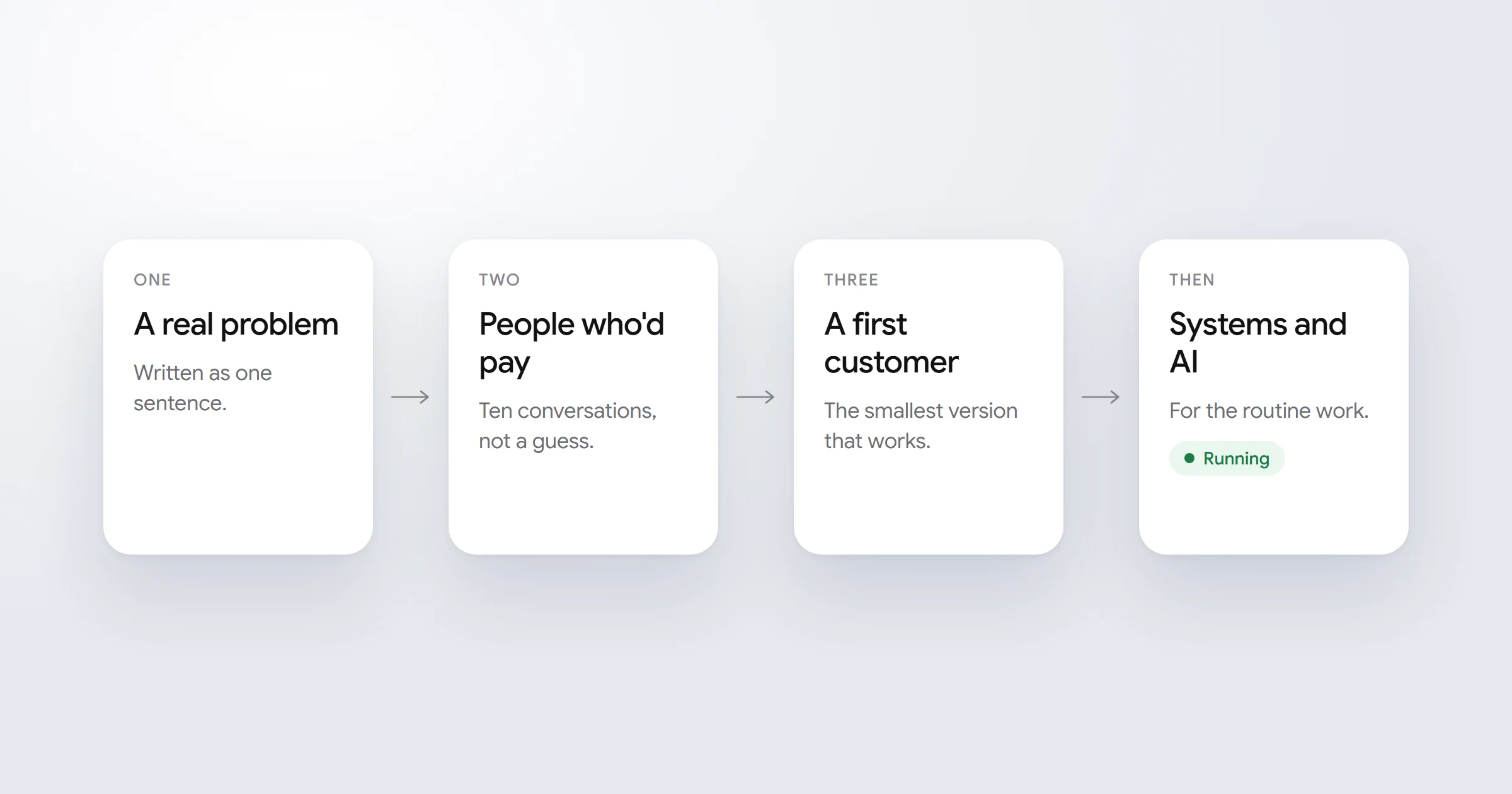
Stackenta helps. We start with what you want the business to do for your life, test whether the idea solves a problem people will pay for, plan how you’ll get your first customers, and set up the systems and AI that run the routine work. Micah has helped people turn ideas into businesses for years, and Isaac builds the AI.
Why do so many business ideas stall?
Usually not because the idea is bad. Many ideas stall between “I have an idea” and “someone paid me.” Nobody has tested whether the problem is real, nobody has planned how the first customers will find out, and the owner has no system for the work that follows. Each of those can be fixed, and the order matters.
What is AI good for at this stage, and what isn’t it?
AI is good at speeding up the thinking. It can help you pressure-test an idea by listing the reasons it might fail and who already sells something similar. It can draft the messages you send, summarize what you learn, and set up the first routines once you know what the business does.
It can’t tell you whether real people will pay. Many people who coach new owners say the fastest way to find out is to talk to a handful of real prospects and ask. AI can help you prepare for those conversations, and it can’t have them for you.
How do we help?
We follow the same three steps as anyone: discover, systematize, automate. For a new business, that looks like this:
- Discover. What do you want the business to give you: the hours you want to work, the income you need, what you want to stop doing? We start with the person, because the right business depends on the life you want.
- Systematize. How will you get customers, how will you serve them, and what will you track? We write it down so the first version is simple and repeatable.
- Automate. We set up AI for the routine work, so your time goes to the customers and the decisions only you can make.
Micah has done this for himself. He had an idea for a startup called Love of Leads, for professionals who need to follow up with leads but can’t afford full-time in-house call services. He designed a system where a lead gets a call back within two minutes, early enough to interrupt their internet scroll, and can then be followed up by text and conversation. The follow-up uses what he called conversation guides instead of scripts, which the professional designs with his help, and a real human does the follow-up.
The interesting part was the back end. It worked like a ride-hailing app: trained people were notified when a lead needed a call or a text, the first to claim a lead owned it and continued the conversation, and they were paid per text or per conversation. That let the business sell fast human response while keeping its own costs extremely low.
He built an enterprise-level SaaS back end and the user experience on the front end, with full SOPs for every step of the process and a software requirements spec for every piece of the software, and he used AI along the way. A bank executive in Asia was interested in licensing it privately.
What can you do this week?
- Write the idea as one sentence about a problem someone has, not a product.
- Name the first ten people who might have that problem.
- Ask each of them whether it is a problem they’d pay to solve, and how they handle it now.
- Write down what you hear, word for word, before you decide anything.
When should you start with free help instead?
If you mainly need a business plan, a loan or the legal basics, a Small Business Development Center or SCORE is a good first stop, and it’s free. We wrote about where they fit and where we do.
When you’re ready to talk, we start with a short initial call booked on this site. If it’s a fit, we set up a free AI audit of about an hour. Book a call, or read the FAQ.