
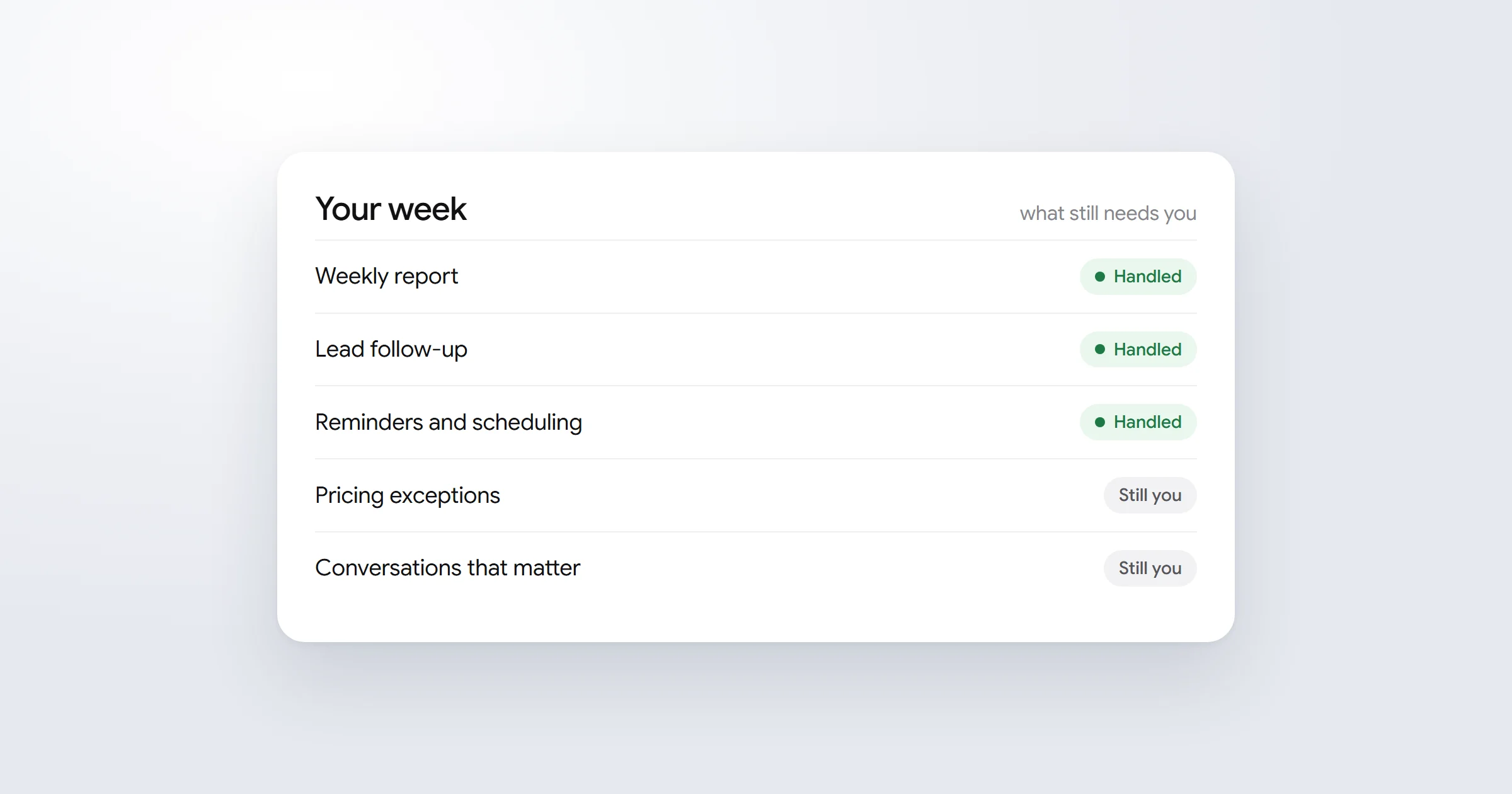
Stackenta can. We start with the work that overwhelms you most, write down how it gets done, and build the automation to take it on, with you approving the results until you trust them. Micah has spent more than 25 years building systems for owners in this position. Isaac builds the AI that runs them. You don’t have to fix everything at once to start.
Why do business owners get overwhelmed?
We recently talked with a shop owner who works six days a week, about 60 hours, and wants far fewer. Micah’s view, from decades of watching this happen, is that most owners don’t crack because they’re not capable. They crack because they carry the whole business on their own back with no systems underneath them. It is easy to see this when times are hard. It happens just as often when things go well.
When business gets good, marketing stops because there is no room for another lead. Content stops because there is no time to make it while serving the customers already there. Then the current work finishes, the pipeline is empty, and the owner spends months climbing back up before it happens again.
Why does “build a system” sound like more work?
Because it often is, at first. Many owners tell us that a system sounds like another job on top of the ones they can’t finish. That is a reasonable reaction. The way to avoid it is to start small and let the work come off your plate in the same step.
What can you do this week?
You can start before you hire anyone:
- List the jobs you repeat. Write down what you do every week that follows a pattern.
- Pick the one that costs you the most. It could be the most time, the most dread or the most delay for your customers.
- Walk through it once, step by step, and write down what you do, including what you do when something goes wrong.
- Decide who could do it. That might be a person, or an AI that drafts and you approve.
How do we help?
In the AI audit, a free conversation of about an hour, we ask what you dread, where your time disappears, and what would hurt most if your business doubled tomorrow. We find the work only you can do and the work you are doing only because no one else knows how. Then a proposal says what to build first. The biggest pain point comes first, because that is where the most weight comes off.
We recently put together a plan for a solo real estate agent who was doing most of it himself, with one part-time assistant. The plan splits the work: his Monday seller reports drafted for him, a newsletter for her to review, a phone line for listing inquiries, a social content system, and a daily list of who to call. Some of it comes off his plate, some off hers, and each has a person approving what goes out.
What stays with you?
The decisions that matter and the conversations that need you. Anything that goes to a customer starts as a draft you approve. You keep your content and data and can export it any time.
To see how this comes together, read how a business can run without its owner. Or book a call.