
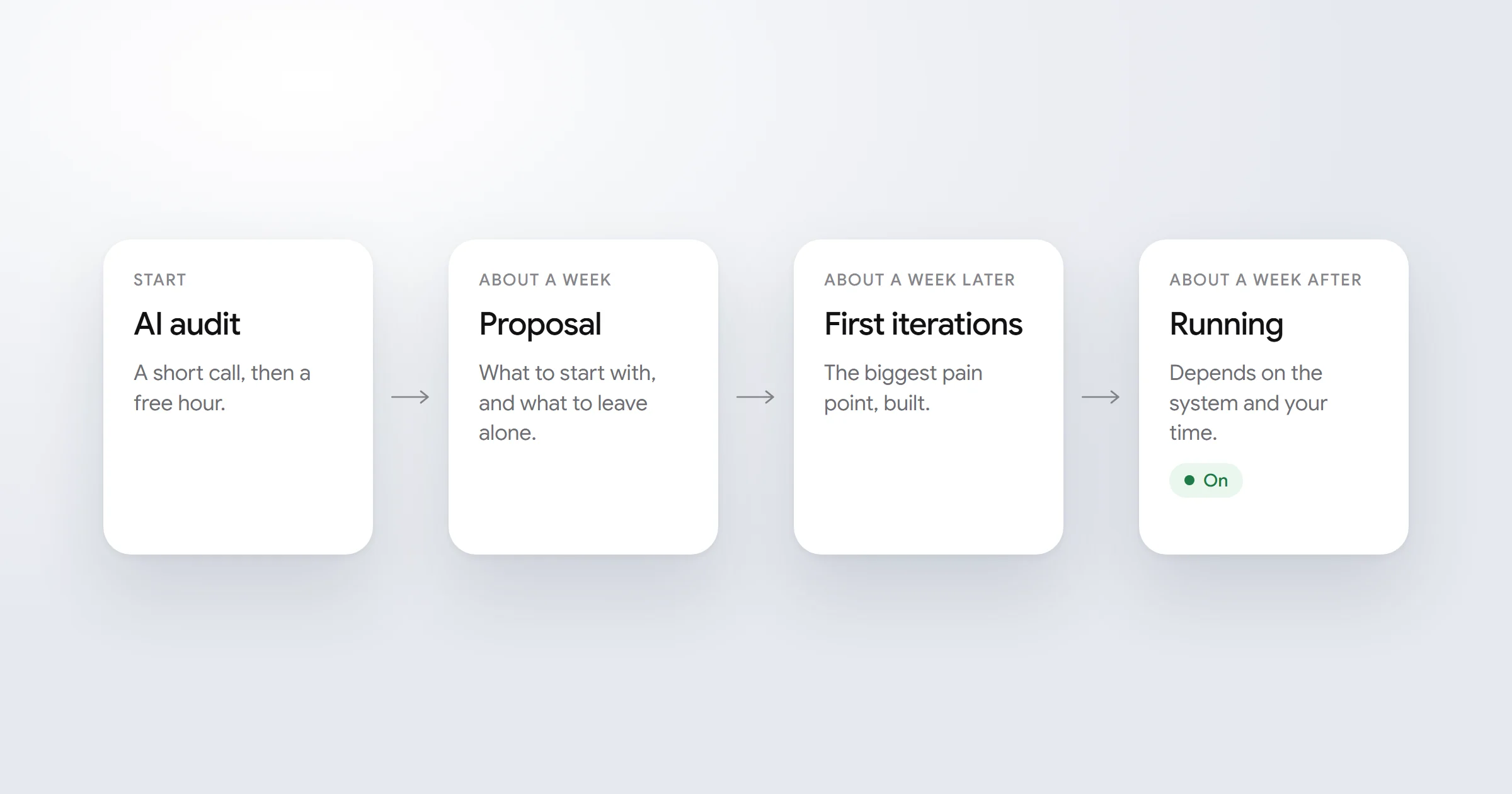
Stackenta can. We start with a short initial call, then a free AI audit of about an hour, and put together a proposal about a week later, and if you accept, the first iterations are typically built within about a week. The full system can be running about a week after that, depending on how complex it is and how much you can take part. Micah designs how the business runs, and Isaac builds the AI that carries it out.
What happens in the AI audit?
When you book a call on this site, we start with a short initial consult. From there we book the AI audit. It is a get-to-know-you consultation, and it is free. We ask about your business and then mostly listen. The topics are:
- What your pain points are, and what you want to accomplish
- How you use AI now, what you’d like to implement, what your experience with AI has been so far, and what worries you about it
- The tools you already use, and anything you tried that didn’t work
- What you like and dislike about running the business, and which task you dread
- Where you want the business to be in a year and in three years
- If your business doubled tomorrow, what would cause you the most pain
- A typical week, or the path from a new lead to a paid invoice, including where information gets retyped
People who do the work can join, and the decision-maker only has to be there for the proposal.
What is in the proposal?
After the consultation we go back to the office and build a full AI proposal, which we deliver about a week later. It is a plan tied to the pain points you named and the goals you described. It covers the workflows we recommend, which one to start with, and what we advise you not to automate. It also gives the cost. We don’t publish prices because each project is scoped to the business, so the proposal is where you see a number.
What do we build?
The system your AI reads, and the routines it runs from it. The system is your business written down in short pages: what you sell, who buys, how you talk, your tools and what happens each week. The routines are the recurring jobs, such as a morning brief, follow-up drafts waiting for your approval, or a report every Monday with the numbers you watch. We cover how that system works in a separate post.
Anything that goes to a customer starts as a draft. You decide when a routine can run on its own.
What is your part?
Time, early on. We ask questions about how your business works, we need your answers on what we draft, and we need you to read and approve what the AI produces until you trust it. The more of that you can do quickly, the sooner the system runs. That is why the timing above says “depending on how much you can take part.”
What do we start with?
The biggest pain point, not the easiest one. We could go faster by picking a small routine and getting something live, and sometimes that is the right call. Our default is to take the problem that costs you the most and fix it first, which takes more planning and some of your participation, and removes the major friction from the business within a few weeks.
Who is this a good fit for?
An owner who has real work repeating every week, a clear idea of what they dislike doing, and the time to answer questions for a couple of weeks. If you want to try something yourself first, we wrote about using ChatGPT for your business once you’re past brainstorming.
To talk through yours, book a call. You can also see how it works.