
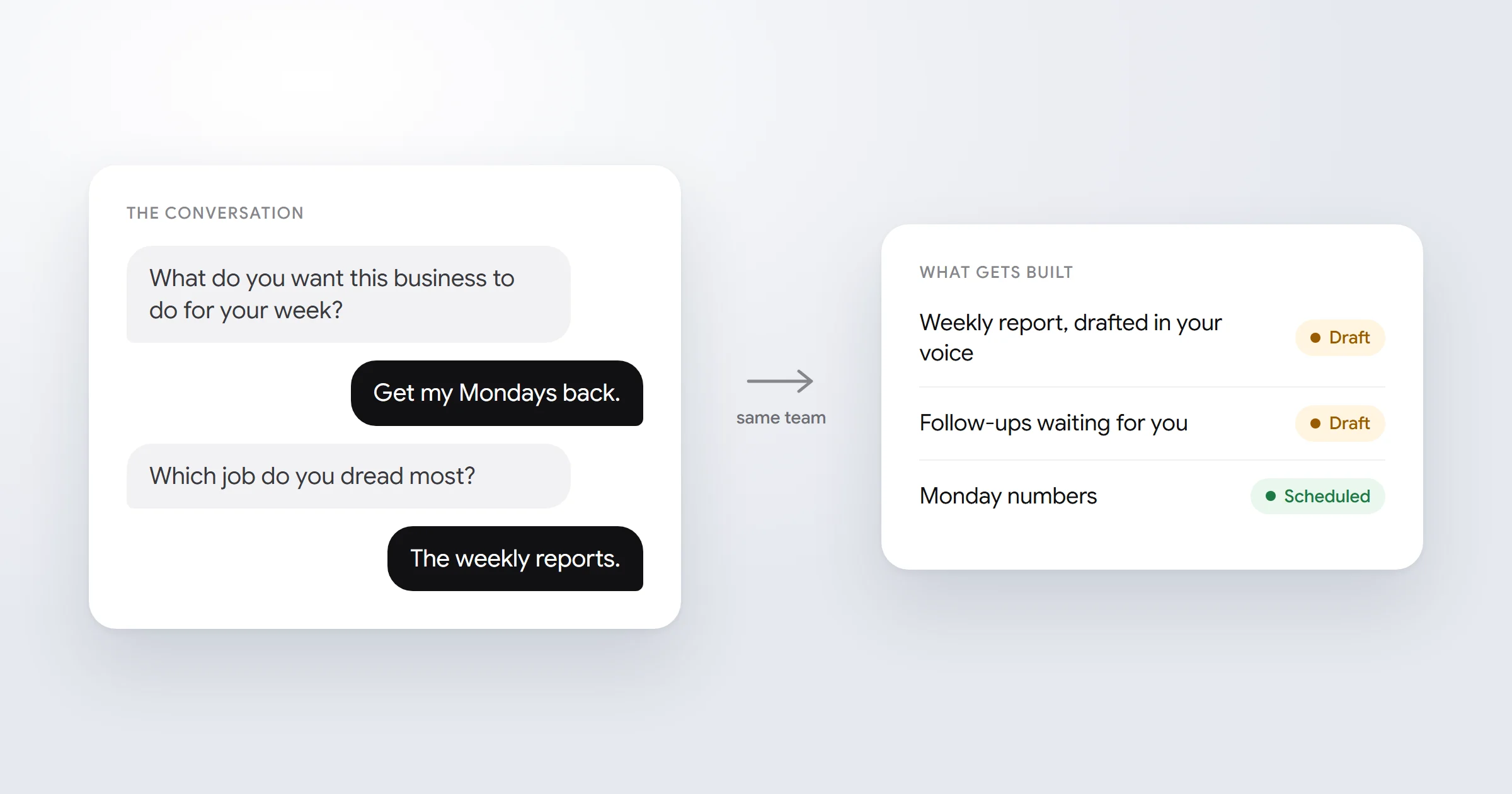
Stackenta is built for owners who want a coach and the AI work in the same place. Micah has coached business owners and real estate agents since the early 2000s, including writing most of a coaching institute’s curriculum. Isaac has put more than 2,000 hours into building with AI and has built enterprise SaaS platforms from scratch. The person who asks what you want from your business is on the same team as the person who builds what you need.
Why is it hard to find a coach who also builds?
Coaching and building are different jobs, and most people are good at one. A coach is good at asking the question you’ve been avoiding. A builder is good at turning a clear request into something that runs on a schedule. When one person claims both, it usually means one half is thinner than the other.
Many AI coaches seem to work the same way: you bring a bottleneck, and in a working session you build the fix yourself with them guiding. That is a fair model if you have the hours and want to learn the tools. Plenty of owners don’t, and they end up with a good coaching call and no system.
What does a coach who builds actually do?
It’s the same three steps every time, in the same order.
- Discover. What do you want the business to do for your life? Which jobs eat your week? A system built before this step tends to automate the wrong thing.
- Systematize. We write down how your business runs in a place your AI can read: what you sell, who buys, how you talk, what happens every week.
- Automate. We connect that to the Claude or ChatGPT you already pay for and give the recurring jobs a schedule.
The coaching conversation shapes what gets built, and the build changes what the next conversation is about. That loop is hard to run when the coach and the builder are two different companies.
What have we done that makes this credible?
Micah wrote the coaching curriculum for a real estate coaching institute, apart from its life skills coaching, traveled to coach high-end agents, and hired and trained that institute’s coaching staff. Before that, in the late 1990s, he wrote an operations manual for a real estate agent that a $6.50-an-hour assistant ran her business from. He later built one of the largest attorney-backed short-sale processing systems in Utah, and he has been a licensed real estate agent since 2001.
Isaac builds the AI side. Beyond the SaaS platforms, he has coached CEOs, business owners and their teams on putting AI to work.
Why does it matter that the coach can see the whole system?
Micah has been on both sides of this. In his early days in real estate he was working as an agent and coaching other agents at the same time, and he had a personal coach for his own business. She didn’t understand what he was building. He was building a big team, and she kept pushing him to do work he believed the team should run. She wasn’t involved in building his systems and didn’t see the whole vision, so her advice kept pointing away from the business he wanted.
More recently he was consulting with a real estate agent on an AI build. The first conversations were about freeing up the agent’s own time, starting with seller listing reports. The agent carries over 15 listings at a time. While working through that, Micah saw that the agent’s part-time assistant was working with a lot of inefficiency. We designed a system that would cut about 90% of the time out of her workflow, freeing her for the tasks that need a human without adding to her hours. It would also put social media content and other work on AI autopilot, so she could handle work that would take two assistants 40 hours a week. And it would cut the agent’s own routine tasks by almost 80%.
The proposal began as a conversation about the agent’s own time and ended up somewhere else. It changed because the person asking the questions could also see where the work was and design the fix.
When is a different option better?
If you want to learn to build every automation yourself, a coach who teaches you at the keyboard is the better fit. If you need a single task done, such as one email routine, ChatGPT’s own tools may be enough, and we wrote about how to use ChatGPT for your business once you’re past brainstorming. If you have a business and no idea what you want from it yet, a coach without a build practice can be a good first step.
We fit best when you want the thinking and the building done together, and you want the result to keep running without you.
What does it look like to work with us?
We start with a call about how your business runs and what you’d like off your plate. Then we follow the three steps. You keep your content and data, and you can export it any time.
If that’s what you’re looking for, book a call. More questions like this are on the FAQ page.